Research Projects
Selected research projects by our founder, Dr Stanislava Boskovic, developed with universities and public institutions before and alongside LRL Space. They bring together design, science and other disciplines, and inform the way LRL Space approaches every project.
Planet-Centric Futures
Advancing Regenerative Design for Thriving Social and Ecological Systems
2024–2026 · Presented at the World Cities Summit 2026, Singapore
Lead author: Dr Stanislava Boskovic, LRL Space, with Hossein Rezai (Ramboll and NUS) and Ana Mijic (Imperial College London)
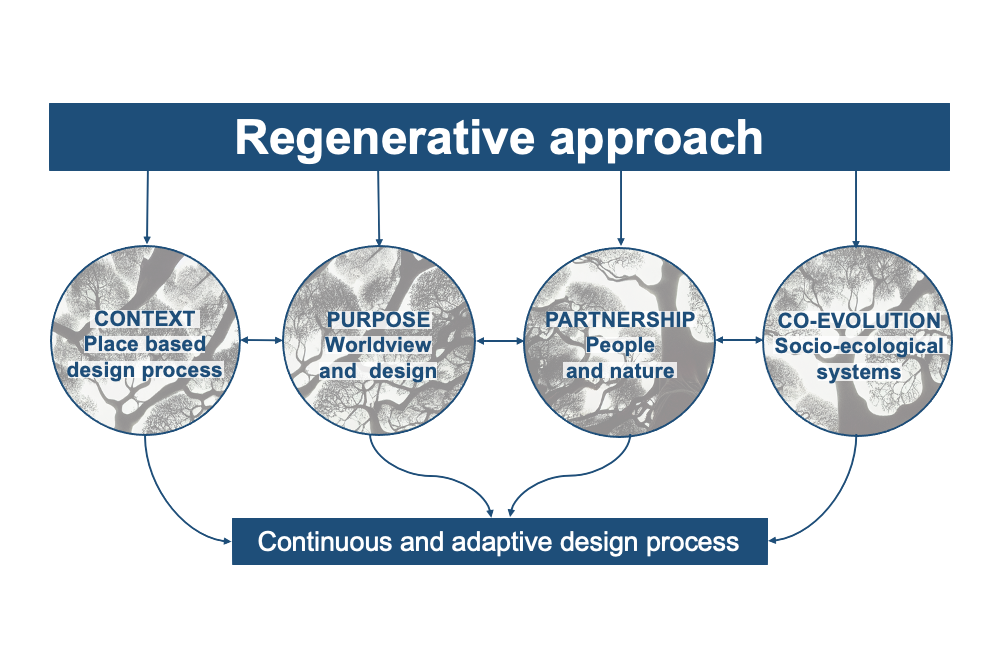
An exploratory study of how regenerative design is emerging within Ramboll, developed with Imperial College London’s Centre for Systems Engineering and Innovation. Through a participatory workshop and interviews with practitioners, it identifies four characteristics of regenerative design: context, purpose, partnership and co-evolution. The study argues that moving beyond harm mitigation towards positive social and ecological outcomes requires a fundamental shift in how we see the relationship between people and nature.
View the poster · Read our news
euPOLIS
Integrated Nature-Based Urban Planning for the Health and Well-being of Citizens
2020–2025 · EU Horizon 2020 research project
Dr Stanislava Boskovic, Research Associate, Imperial College London, Centre for Systems Engineering and Innovation
An EU-funded research project on bringing nature-based solutions (green spaces, vegetation and water) into urban planning to improve public health, mental well-being and climate resilience. Instead of relying only on outdated engineering infrastructure, euPOLIS replaced or combined it with natural ecosystems that boost biodiversity, manage water and support physical and mental health. The methodology was tested in four demonstration cities, Belgrade, Łódź, Piraeus and Gladsaxe, and shared with the follower cities Limassol, Palermo, Bogotá and Trebinje.
Stanislava worked with urban planning authorities on stakeholder engagement and capacity building, edited the euPOLIS magazine and co-authored “An Introduction to the euPOLIS Project” (2021). She presented the project’s systemic design approach at Ramboll’s Design Excellence Forum in 2022, at the EGU General Assembly in Vienna in 2023 and at the European Public Health Conference in Lisbon in 2024. She also took part in public forums such as “Towards a Network of Sustainable Cities” with Universidad de los Andes in Bogotá in 2021. The project ended with its final conference in Piraeus on 26 August 2025.
Visit the euPOLIS website · Read the magazine · RDEF 2022 publication · EGU 2023 abstract · Read the paper

HEART
Healthier Cities Through Blue-Green Regenerative Technologies
2021–2025 · EU Horizon 2020 research project
Dr Stanislava Boskovic, Research Associate, Imperial College London, Centre for Systems Engineering and Innovation
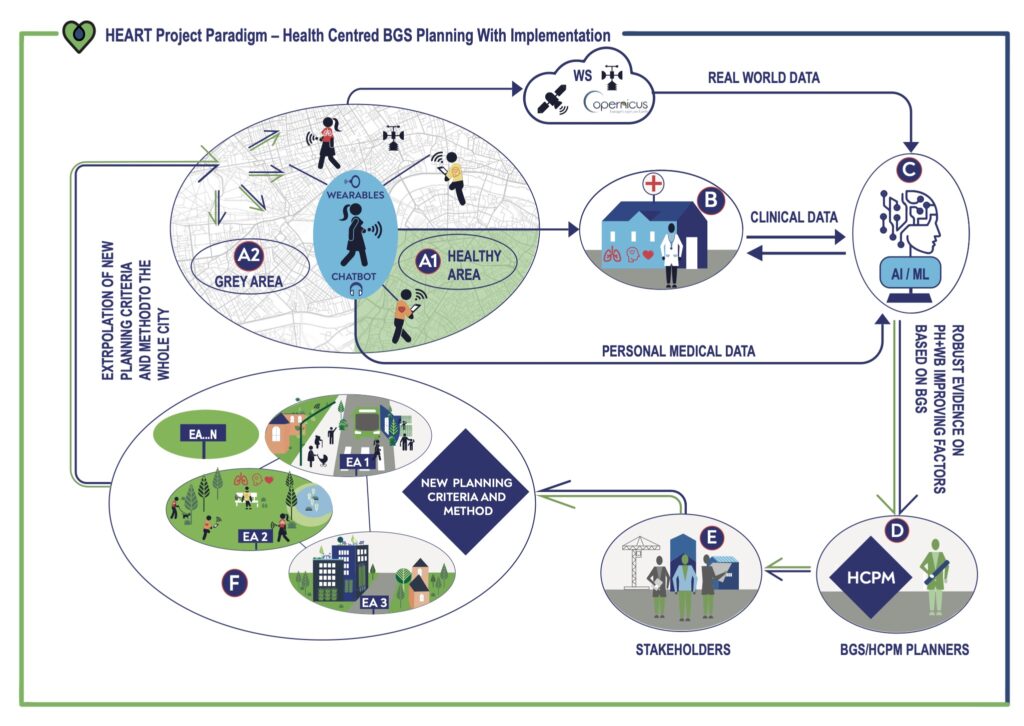
An EU-funded research project on how blue-green solutions in cities (natural ecosystems, vegetation and water woven into the urban fabric) can improve citizens’ health. Coordinated by the National Technical University of Athens with 19 partners from health, urban planning, social sciences, technology and city utilities, HEART focused on metabolic, mental, cardiovascular and respiratory conditions. It combined clinical data, wearables, satellite and environmental data to build robust evidence and develop a new Health-Centred Planning Method, tested in demonstration areas in Athens, Belgrade and Aarhus.
Stanislava worked with urban planning authorities on stakeholder engagement and capacity building, and co-authored “HEAlthier Cities through Blue-Green Regenerative Technologies: the HEART Approach” (2024), which presents the project’s intermediate results. She presented HEART at Ramboll’s Design Excellence Forum in 2022, and in November 2024 she spoke in a plenary session at the European Public Health Conference in Lisbon, organised by the European Health Management Association, on bringing health-oriented decision-making into architecture and urban planning.
Visit the HEART website · RDEF 2022 publication · EPH 2024 plenary · Read the paper
SAPID
Systems Approach to Data-Driven Integrated Urban and Infrastructure Planning
2021–2023 · The Alan Turing Institute, Data-Centric Engineering programme
Dr Stanislava Boskovic, Research Associate, Imperial College London, with Professor Jennifer Whyte, Professor Ana Mijic, Pepe Puchol-Salort and Eduardo Rico
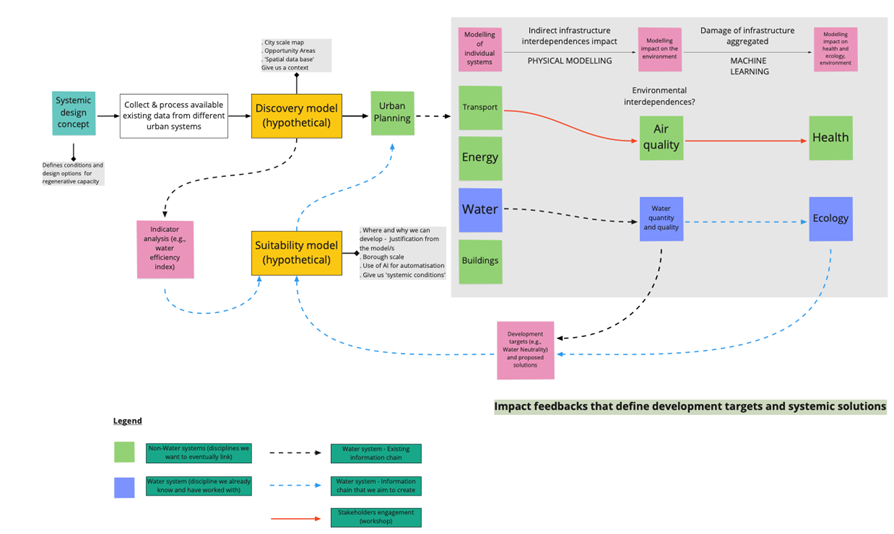
A research project on how urban data can support integrated urban and infrastructure planning. SAPID developed prototypes of two connected models. A Discovery Model gathers existing data from different urban systems to map opportunities and constraints for local plans. A Suitability Model then combines this with infrastructure modelling to find the best places for new development and the retrofits it would need. Using water infrastructure as a case study, the project linked development to water quality, ecology and human health, and explored through a participatory workshop how the approach could extend to energy, transport and air quality.
Stanislava developed the systemic design concept at the start of the framework, which defines the conditions and design options for regenerative capacity, and co-organised the participatory stakeholder workshop. SAPID was part of the wider VENTURA project, which created and tested a prototype digital tool for collaborative, early-stage strategic planning of future water management in Greater Manchester and Enfield, London, with Imperial College London, UCL and the British Geological Survey. The work informed the conference paper “Water-Neutral Systemic Design and Planning Decisions Across Different Urban Scales”, presented at PLEA 2024 in Wrocław.
Visit the SAPID project page · VENTURA briefing note · Read the paper